Review by Alistair Quietsch
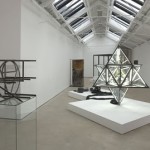
Dirk Bell’s work is a diverse mix of masterly observed drawings, minimalist sculpture and an artistic play with technology. Upon entering the show there is a large mix of objects to piece together. Darkly toned paintings of rotten apples looking like organs juxtaposed against a seemingly rigid large steel grid pattern. Two skilfully drawn eyes avoid each others gaze in the far corner while a giant striplight star structure clicks and fizzes governing the centre of the space, humming off an irresistible omnipresent sleekness. It is this piece that truly adds the ambience to the show, its presence dominates the space and intrigues onlookers, with its immaculate black and white sheen of steel and glass.
In the space, Bell is playing with various themes, all core to the human condition: belief, myth, society, freedom and love. It is through these themes that the work’s ambiguity begins to shed away and a more connected body forms. On first impressions it can come across as a ragtag collection of pristine metal work and shabby found materials, of old dirty doors and lazy canvas draping all banded together in a white cube space. But look closer and suddenly there is a nude posing, elegantly drawn by erasing dirt from the shabby door. Two apples eaten away at the core hug one another in a yin-yang style pairing, wrinkly and somehow pleasingly real. It all begins to fall into place when the large metal grids, no longer some coldly executed minimalist throwback, suddenly appear to spell FREEDOM and another smaller cube spells LOVE like a clever take on the Robert Indiana sculptures.
You would think there is the risk of the work coming across as kitsch, especially with such hippie themes such as love and freedom but Bell’s clever balance of darkness and concept thankfully make the pieces more powerful than soppy.
However it is in the giant striplight sculpture, that sits atonally Om-ing, that the current of Bell’s efforts seem to have adeptly flown, which also securely breaks him away from any kind of bland posing. Stood on a slight stage a laptop sits seemingly playing through various images on a 3 Dimensional replica of the exhibition space. Running out from it are wires connecting it to a PA system, speakers, and a snare drum. From this drum thicker black wires feed the giant star in a Matrix style winding and eerie weaving of black and white tubes. The stuff of sci-fi fans dreams. Titled Merkaba, the piece is a complex comment on technology (even going as far as to say gamer culture), society and religion. Through the laptop the viewer is invited to enter the video game where the objective is to collect and gain “LOVE” and “FREEDOM” as they float around in the on screen 3 Dimensional replica. As you collect each keyword an Eastern monastery style chime follows and lights flicker within the star.
The intelligence behind the piece is not only in its laborious production but also in its play with concepts. It appears to be a sharp comment on some video games that play with the idea of society, The Sims and World of Warcraft to name a few, where the root objective is always to collect goals and therefore ascend to a higher level within the game. In terms of The Sims this is through making friends, keeping your character happy by letting them play, eat, sleep and interact with others, essentially mirrored in Bell’s collecting of LOVE and FREEDOM as if they were commodities that could be picked up at a shopping centre. Through this there is the parody that if you have collected enough LOVE and FREEDOM you will ascend to some other plane. In the game you are bumped around in the basic graphics until you finally begin to well up into the sky. To accentuate this the title of the piece, and the Jewish Star of David shape, points directly to this idea of ascension. In Kabbalah studies the Merkaba is the chariot of God and through the decoding of the Ezekiel passages the reader can learn the secrets of creation and eventually reach an ascended status. Through Dirk Bell’s play with technology he has adapted this myth into our current consumer culture and plays it off well, possibly mockingly, in his giant Star to Enlightenment.
Generally the work seems to be planted firmly in the esoteric myths of the Greeks, Jews and Christians: the stuff of Crowley books and Kabbalah, but each with an interesting contemporary reinvention. It is safe to say that Bell is a very Gothic artist (perhaps a trait of his Germanic birthplace) both in his Da Vinci level of rendering but also in his steady grasp of spiritual themes and overall dark motif. There is also the level of conceptual probing within the very broad themes of the show, with the CCA and Bell having even devoted the entire upper half of his show to allowing philosopher Marcus Steinwen to set up analytic diagrams breaking down complex webs of theory regarding art, societies, truth and being.
It could be a criticism that the work is grounded in the place of fantasy; of magic and spells, and some may be put off with the work that Bell creates around these themes, but I would say it is refreshing to see a show that is not just a sarcastic self-reference to the art world. It plays on the wide range of folklore and creativity that has gone into the cannon of human spirits and makes the world seem a bit more magical instead of just mechanical.
For more information on the forthcoming programme at The Modern Institute please visit